Ep 5 Game Rules: Animal Crossing | Gamebreaker
WHAT IS THIS?
This post explains the rules of the game featured in Episode 5 of Gamebreaker.
These posts will be split into two sections:
Section 1 is the rules of the game as presented in the episode. This is for viewers who find reading rules helpful for game comprehension, or wanted to check a specific rule.
Section 2 is for people who want to try and play the game themselves with friends. It will include extra information on top of the rules explained in section 1, and suggestions to adapt the game outside of the competition format. Section 2 may contain spoilers for the episode.

SECTION 1: RULES FOR GAME
Game Summary:
In animal crossing, players are animals stranded on a desert island, trying to cross the water on rafts back home. There are two rafts (couches A and B), one island (rug in between them), and the floor represents the water.
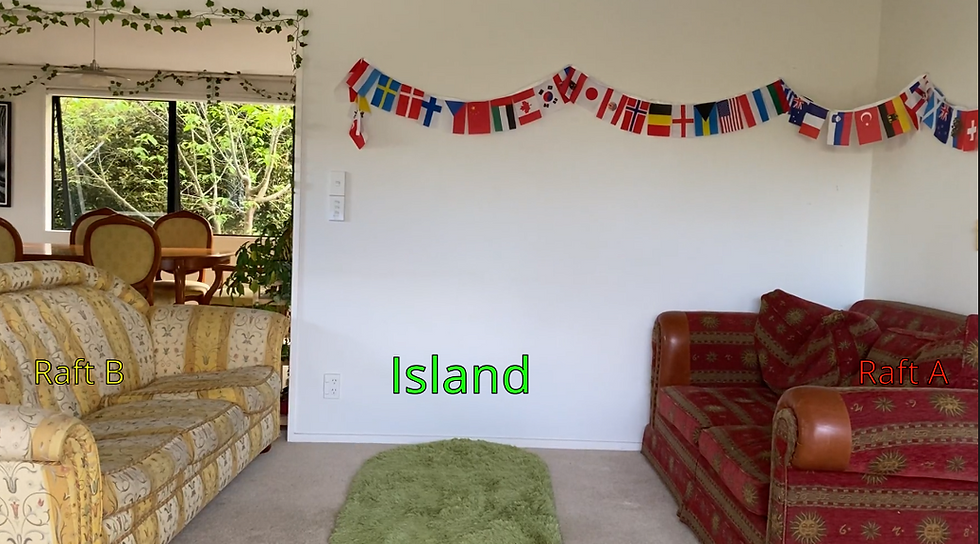
Each round, players choose the animal they want to be in private, and score points if they board a raft that does not sink. Heavier animals score more points. If a player remains on the island, they score a point for each player that sunk that round. There will be five rounds of Animal Crossing.
Competition results:
Whoever scores the most points will earn a complete GB token.
Whoever scores the least points will get a strike.
Additionally, every player who scores more than 10 points in the game will get a bonus half a GB token.
ROUND GAMEPLAY:
Raft weight announcement:
At the start of the round, the maximum weight each raft can carry will be announced.
These values change every round, and vary between 2 and 10.
(Eg. Raft A = 3, Raft B = 8)
(The island has no maximum weight load)
Animal selection phase:
Players then have 7 minutes to strategize and select their animal in private.
There are four animals to choose from:
Mouse (weight 1), Cat (weight 2), Dog (weight 3) and Elephant (weight 5).

Once the 7 minutes are up, players who have not yet selected their animal will be called upon to decide.
Boarding phase:
Players then have 30 seconds to board a raft.
Players are banned from (intentionally) physically interacting with each other during the boarding phase. Strictly no pushing or restraining.
Whichever raft a player is on when the timer goes off, is the raft they boarded.
Alternatively, players can stay on the island.
If the raft a player boarded is able to make a crossing, they will score points equal to the weight of the animal they chose (eg. an elephant will score you 5 points for a successful crossing).
However, if a player sinks, they score nothing for that round. A player sinks if:
Any part of them touches the water (floor) when the timer goes off.
Any animals on the raft they boarded scare the player’s animal off the raft (see animal traits).
The maximum weight load of the raft they boarded is exceeded.
(I.e. The combined weight of all animals remaining on the raft exceeds the rafts weight load).
Players cannot sink on the island. Any players who chose to stay on the island will score a point for every player who did sink that round.
Round end:
After the timer goes off, the round ends, and the players who sank are announced publicly.
Players scores and animal selections will not be revealed.
Animals traits:
Certain animals cannot board the same raft without being scared off.
If an animal is scared off a raft, that player is considered to have “sunk”.
Mouse (weight 1)
+ Mice scare all elephants off the raft they boarded.
+ Score a bonus point for every mouse on the same raft.
(eg. if three mice board a raft, every mouse scores 3 instead of 1).
- Mice are scared off a raft if a cat boards it.
Cat (weight 2)
+ Cats scare all mice off the raft they boarded.
- Cats are scared off if dogs outnumber cats on the raft they boarded.Dog (weight 3)+ If dogs outnumber cats on the raft they boarded, all the cats are scared off the raft.- Dogs cannot score points on the island.
Elephant (weight 5)
+ I mean, five points is pretty good!
- Elephants are scared off if there are any mice on the raft they boarded.
There is no order of process in terms of animal interactions, I.e. they cause each other to sink simultaneously. (See the example round)

Example round:
Five players board raft A, which has a maximum weight load of 7.
The animals the players on the raft picked are: two dogs, one cat, one mouse and one elephant.
The combined weight of these animals is 14.
Animal interactions are resolved first:
Two dogs outnumber one cat, so the cat is scared off.
The cat scares off the mouse.
The mouse scares off the elephant.
This all happens simultaneously. The three scared off animals “sink”, so only the two dogs remain on the raft.
Dogs have a weight of three, so their combined weight on the raft is 6.
This is below raft A’s max weight load of 7. Therefore, these two players who picked dogs make a successful crossing, and score 3 points each!
The sixth player chose to stay on the island.
As three players sank that round (cat, mouse, elephant), as per the rules of the island, the player on the island would score 3 points (unless they chose dog as their animal for that round, then they would score nothing, as dogs don’t score points on the island).

SECTION 2: FOR PLAYING YOURSELF.
Player count: 6 players is ideal as seen in the episode.
If you want to play with more than 6 players, rather than increase the maximum weight loads of the two rafts, I’d add a third raft with the same range of 2 to 10.
Materials: A timer that makes noise.
Optional: Fluffy animals! Otherwise players can just announce to the Games Master their animal selection.
Rafts, island and water: If you don’t want to go jumping around on your furniture, you can also substitute the couches for rugs. You could also use tape/rope to mark out where the rafts and island are on the floor. Make sure to clear the floor in the play area beforehand! Alternatively, you can make it into an actual board game, using carboard or similar to construct rafts and island, and give player tokens to mark which raft they want to board.
Playing the game:
This game can be played as seen in the episode with a Games Master, who must keep track of animal traits, who sinks, and total scores.
However, Animal Crossing can also be played without a Games Master with the following modifications:
Every player is given an envelope/bag and a single “token” for each of the four animals (This can be a drawing, the animal’s name on a slip of paper, whatever works.)
One at a time players enter the private area to decide which animal they want to be for that round. They keep the token of the animal they want to select in the envelope/bag, then hide the others in a private “locker” no one else is allowed to access (the locker can just be another envelope/bag ect.)
Once every player has only one animal token hidden on their person, the boarding phase plays as usual.
When the round ends, all players reveal their animals, and work out who sinks and who scores points. In this version, scores are public.
Raft weight loads:
If you wish, you can randomise the raft weight loads (between 2 and 10).
However, I specifically chose the weight loads featured in the episode (including the practice round) based on which I thought posed the most interesting scenarios for the players, so I’d actually recommend using the same ones.
Raft sizes used in episode:
A: 4 B: 6
A: 4 B: 7
A: 5 B: 5
A: 2 B: 10
A: 6 B: 7
A: 8 B: 10
If you want to add/change some, or add a third raft for more players, think of all the different combinations of animal that can work with that weight load (it’s no fun if every player can just pick elephant).
As a general guide, multiply the number of players by 2 and that's a good average for both rafts combined to carry. (In the episode, 6 players x 2 = 12 combined weight)
I think this game is one of the easier ones to adapt and play at home outside the competition format, so please give it a try and tell me what you think!


Comments